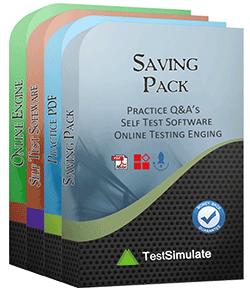
Download CompTIA : 220-901 Questions & Answers as PDF & Test Software
Updated: Jun 02, 2026
No. of Questions: 695 Questions & Answers with Testing Engine
Download Limit: Unlimited
Reliable & Actual Study Materials for 220-901 Exam Success
Our Online Test Engine & Self Test Software of TestSimulate 220-901 actual study materials can simulate the exam scene so that you will have a good command of writing speed and time. Then multiple practices make you perfect while in the real CompTIA 220-901 exam. The package practice version will not only provide you high-quality 220-901 exam preparation materials but also various studying ways.
100% Money Back Guarantee
TestSimulate has an unprecedented 99.6% first time pass rate among our customers.  We're so confident of our products that we provide no hassle product exchange.
- Best exam practice material
- Three formats are optional
- 10 years of excellence
- 365 Days Free Updates
- Learn anywhere, anytime
- 100% Safe shopping experience
- Instant Download: Our system will send you the products you purchase in mailbox in a minute after payment. (If not received within 12 hours, please contact us. Note: don't forget to check your spam.)
220-901 Online Engine

- Online Tool, Convenient, easy to study.
- Instant Online Access
- Supports All Web Browsers
- Practice Online Anytime
- Test History and Performance Review
- Supports Windows / Mac / Android / iOS, etc.
- Try Online Engine Demo
220-901 Self Test Engine

- Installable Software Application
- Simulates Real Exam Environment
- Builds 220-901 Exam Confidence
- Supports MS Operating System
- Two Modes For Practice
- Practice Offline Anytime
- Software Screenshots
220-901 Practice Q&A's

- Printable 220-901 PDF Format
- Prepared by 220-901 Experts
- Instant Access to Download
- Study Anywhere, Anytime
- 365 Days Free Updates
- Free 220-901 PDF Demo Available
- Download Q&A's Demo
What is Difficulty for COMPTIA 220-901
Trouble degree for the 220-901 exam. There are a couple of tests to look at, and also the 220-901 CompTIA is among the harder. There are a few reasons for this. To begin with, it's an old exam, from 2001. So the layout of the questions has altered little since then. Secondly, there are unrestricted efforts to take 220-901 CompTIA, and also bear in mind that you will obtain not all these efforts in one day. You will get endless attempts to take the actual 220-901 CompTIA exam, and also you can take your exams over a time period. Holiday accommodations are made for those with special demands, so you can save your exam responses up until you prepare to take the real exam. This makes it harder to examine for this certain exam, and it makes it more difficult to pass. CompTIA A+ has 2 exams: 220-901 (equipment) and also 220-902 (software application). However, the software application test is a lot more difficult than the hardware one. It's been by doing this for several years now. Yet one more point is that CompTIA 220-901 exams are open publication and that indicates you can utilize whatever product you require. It's not a negative suggestion to obtain a broad understanding of the subject through which you'll be evaluated on CompTIA 220-901 exams prior to trying them as they might additionally enhance your chances of passing the tests with high scores much easier. Yet, it isn't very hard nonetheless you call for to understand the fundamentals of networking and also networking tools.
A number of IT professionals have had issues with the 220-901 CompTIA exam, yet there are numerous who have gotten their certification with no concern after preparing with our 220-901 Dumps. It is prescribed to bear in mind that if you are not a networking and networking devices expert, after that you will have concerns with the 220-901 CompTIA test. Regardless of whether this might not be a solid case for you, it is still recommended to first comprehend the basics of networking as well as major tenets of networks. If you achieve some knowledge concerning the fundamentals of the CompTIA 220-901 exam, what subject will certainly be checked out as well as what topics are normally evaluated, it will certainly be less demanding for you to obtain some assistance with passing the exam in the round. There are numerous resources available where you can gain some expertise on this subject and also iron out the basic concepts without having any type of concerns. Learning is a crucial ingredient to success for any type of specialist in IT.
CompTIA A+ Exam Certification Details:
| Schedule Exam | CompTIA Marketplace |
| Exam Price | $219 (USD) |
| Exam Code | 220-901 |
| Sample Questions | CompTIA A+ Sample Questions |
| Exam Name | CompTIA A+ |
| Number of Questions | 90 |
| Duration | 90 mins |
| Passing Score | 675 / 900 |
Reference: https://certification.comptia.org/certifications/a
How to Prepare for CompTIA A+
Preparation Guide for CompTIA A+
Complete overview of CompTIA A+
If you're planning on taking the CompTIA A+ exam after preparing with our 220-901 Dumps, or you understand somebody that is, then you may be wondering exactly how to prepare for it. The good news is that there are numerous resources readily available to aid you. This blog post will offer a review of the research products and tools presently offered for exam prep work.
Before we enter into real research study material though, I seem like I should mention just what the CompTIA A+ certification covers. The exam will certainly test your expertise in computer and peripherals, mobile computer, networking, cloud computer, repairing operating systems and various other software programs, safety and security, and threat administration.
CompTIA 220-901 Exam Syllabus Topics:
| Topic | Details |
|---|---|
| Hardware34% | |
| Given a scenario, configure settings and use BIOS/UEFI tools on a PC. | 1. Firmware upgrades/flash BIOS 2. BIOS component information
3.BIOS configurations
4.Built-in diagnostics
|
| Explain the importance of motherboard components, their purpose and properties. | 1.Sizes
2.Expansion slots
3.RAM slots
6.CMOS battery
10.Bus speeds |
| Compare and contrast various RAM types and their features. | 1.Types
a)Single channel vs. dualchannel vs. triple channel
2.RAM compatibility |
| Install and configure PC expansion cards. | 1.Sound cards 2.Video cards 3.Network cards 4.USB cards 5.Firewire cards 6.Thunderbolt cards 7.Storage cards 8.Modem cards 9.Wireless/cellular cards 10.TV tuner cards 11.Video capture cards 12.Riser cards |
| Install and configure storage devices and use appropriate media. | 1.Optical drives
2.Magnetic hard disk drives
3.Hot swappable drives
5.RAID types
6.Tape drive
|
| Install various types of CPUs and apply the appropriate cooling methods. | 1.Socket types
|
| Compare and contrast various PC connection interfaces, their characteristics and purpose. | 1.Physical connections
3.Characteristics
|
| Install a power supply based on given specifications. | 1.Connector types and their voltages
|
| Given a scenario, select the appropriate components for a custom PC configuration to meet customer specifications or needs. | 1.Graphic/CAD/CAM design workstation
2.Audio/video editing workstation
3.Virtualization workstation
4.Gaming PC
5.Home theater PC
6.Standard thick client
|
| Compare and contrast types of display devices and their features. | 1.Types
2.Refresh/frame rates
|
| Identify common PC connector types and associated cables. | 1.Display connector types
2.Display cable types
3.Device cables and connectors
4.Adapters and convertors
|
| Install and configure common peripheral devices. | 1.Input devices
2.Output devices
3.Input & output devices
|
| Install SOHO multifunction device/printers and configure appropriate settings. | 1.Use appropriate drivers for agiven operating system
2.Device sharing
3.Public/shared devices
|
| Compare and contrast differences between the various print technologies and the associated imaging process. | 1.Laser
2.Inkjet
3.Thermal
4.Impact
5.Virtual
|
| Given a scenario, perform appropriate printer maintenance. | 1.Laser
2.Therma
3.Impact
4.Inkjet
|
| Networking 21% | |
| Identify the various types of network cables and connectors. | 1.Fiber
2.Twisted Pair
3.Coaxial
|
| Compare and contrast the characteristics of connectors and cabling. | 1.Fiber
2.Twisted pair
3.Coaxial
|
| Explain the properties and characteristics of TCP/IP. | 1.IPv4 vs. IPv6 2.Public vs. private vs. APIPA/link local 3.Static vs. dynamic 4. Client-side DNS settings 5.Client-side DHCP 6. Subnet mask vs. CIDR 7.Gateway |
| Explain common TCP and UDP ports, protocols and their purpose. | 1.Ports
2.Protocols
3.TCP vs. UDP |
| Compare and contrast various WiFi networking standards and encryption types. | 1.Standards
2.Encryption types
|
| Given a scenario, install and configure SOHO wireless/ wired router and apply appropriate settings. | 1.Channels 2.Port forwarding, port triggering 3.DHCP (on/off) 4.DMZ 5.NAT/DNAT 6.Basic QoS 7.Firmware 8. UPnP |
| Compare and contrast Internet connection types, network types and their features. | 1.Internet connection types
2.Network Types
|
| Compare and contrast network architecture devices, their functions and features. | 1.Hub 2.Switch 3.Router 4.Access point 5.Bridge 6.Modem 7.Firewall 8.Patch panel 9.Repeaters/extenders 10.Ethernet over Power 11.Power over Ethernet injector |
| Given a scenario, use appropriate networking tools. | 1.Crimper 2.Cable stripper 3.Multimeter 4.Tone generator and probe 5.Cable tester 6.Loopback plug 7.Punchdown tool 8.WiFi analyzer |
| Mobile Devices 17% | |
| Install and configure laptop hardware and components. | 1.Expansion options
2.Hardware/device replacement
|
| Explain the function of components within the display of a laptop. | 1.Types
2.WiFi antenna connector/placement |
| Given a scenario, use appropriate laptop features. | 1.Special function keys
Airplane mode |
| Explain the characteristics of various types of other mobile devices. | 1.Tablets 2.Smartphones 3.Wearable technology devices
4.Phablets |
| Compare and contrast accessories and ports of other mobile devices. | 1.Connection types
|
| Hardware and Network Troubleshooting 28% | |
| Given a scenario, troubleshoot common problems related to motherboards, RAM, CPU and power with appropriate tools. | 1.Common symptoms
Distended capacitors 2.Tools
|
| Given a scenario, troubleshoot hard drives and RAID arrays with appropriate tools. | 1.Common symptoms
|
| Given a scenario, troubleshoot common video, projector and display issues. | 1.Common symptoms
|
| Given a scenario, troubleshoot wired and wireless networks with appropriate tools. | 1.Common symptoms
2.Hardware tools
3.Command line tools
|
| Given a scenario, troubleshoot and repair common mobile device issues while adhering to the appropriate procedures. | 1.Common symptoms
|
| Given a scenario, troubleshoot printers with appropriate tools. | 1.Common symptoms
2.Tools
|
I passed the exam yesterday with 92% marks. I saw similar questions to these 220-901 practice questions on the exam. I'm very satisfied and will definitely use this site again.
 By Bblythe
I took this exam and passed with an good score. I got most of the questions from the 220-901 dumps on the exam.
By Eden
Hey guys, I want to say that I use the 220-901 Exam dumps from TestSimulate. They are good. I passed using these in the very first attempt.
By Hazel
I used the 220-901 dumps here at TestSimulate. They are very accurate, up-to-date and relevant. I recommend to use them.
By Kimberley
Excellent quality 220-901 exam dumps! Recommended to all 220-901 candidates.
By Michelle
Won my dream 220-901 certification!
Easy victory in exam 220-901!
By Prima
Disclaimer Policy: The site does not guarantee the content of the comments. Because of the different time and the changes in the scope of the exam, it can produce different effect. Before you purchase the dump, please carefully read the product introduction from the page. In addition, please be advised the site will not be responsible for the content of the comments and contradictions between users.

TestSimulate 220-901 practice test engine provide users the most accurate exam materials so that users can have a good learning about your exam. Most examinees choose our practice test engine as their only exam materials and pass exam successfully. Our high-quality 220-901 practice test engine should be helpful for every user if you pay attention on our exam questions. Every penny will be worth.
Or if you are afraid, we have money back guarantee policy that if you fail exam after purchasing our 220-901 practice test engine, we will full refund to you soon if you send us your failure score scanned and apply for refund. No Pass, Full Refund!
Frequently Asked Questions
Are your materials surely helpful and latest?
Yes, our 220-901 exam questions are certainly helpful practice materials. Our pass rate is 99%. Our 220-901 exam questions are compiled strictly. Our education experts are experienced in this line many years. We guarantee that our materials are helpful and latest surely. If you want to know more about our products, you can download our PDF free demo for reference. Also we have pictures and illustration for Self Test Software & Online Engine version.
When do your products update? How often do our 220-901 exam products change?
All our products are the latest version. If you want to know details about each exam materials, our service will be waiting for you 7*24*365 online. Our exam products will updates with the change of the real 220-901 test. It is different for each exam code.
How long will my 220-901 exam materials be valid after purchase?
All our products can share 365 days free download for updating version from the date of purchase. So don't worry. The exam materials will be valid for 365 days on our site.
How can I know if you release new version? How can I download the updating version?
We have professional system designed by our strict IT staff. Once the 220-901 exam materials you purchased have new updates, our system will send you a mail to notify you including the downloading link automatically, or you can log in our site via account and password, and then download any time. As we all know, procedure may be more accurate than manpower.
Should I need to register an account on your site?
No. After purchase, our system will set up an account and password by your purchasing information. You can use it directly or you can change your password as you like. No need to register an account yourself.
Do you have money back policy? How can I get refund if fail?
Yes, we have money back guarantee if you fail exam with our products. Applying for refund is simple that you send email to us for applying refund attached your failure score scanned. Money will be back to what you pay. Normally we support Credit Card for most countries. Our refund validity is 60 days from the date of your purchase. Our customer service is 365 days warranty. Users can receive our latest materials within one year.
What is the Self Test Software? How to use it? How about Online Test Engine?
Self Test Software should be downloaded and installed in Window system with Java script. After purchase, we will send you email including download link, you click the link and download directly. If your computer is not the Window system and Java script, you can choose to purchase Online Test Engine. It is available for all device such Mac.
Can I purchase PDF files? Can I print out?
Yes, you can choose PDF version and print out. PDF version, Self Test Software and Online Test Engine cover same questions and answers. PDF version is printable.
How many computers can Self Test Software be downloaded? How about Online Test Engine?
Self Test Software can be downloaded in more than two hundreds computers. It is no limitation for the quantity of computers. So does Online Test Engine. You can use Online Test Engine in any device.
Over 73306+ Satisfied Customers