Download Microsoft : 70-466 Questions & Answers as PDF & Test Software
Last Updated: Jun 01, 2026
No. of Questions: 186 Questions & Answers with Testing Engine
Download Limit: Unlimited
Reliable & Actual Study Materials for 70-466 Exam Success
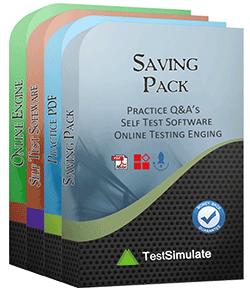
Our Online Test Engine & Self Test Software of TestSimulate 70-466 actual study materials can simulate the exam scene so that you will have a good command of writing speed and time. Then multiple practices make you perfect while in the real Microsoft 70-466 exam. The package practice version will not only provide you high-quality 70-466 exam preparation materials but also various studying ways.
100% Money Back Guarantee
TestSimulate has an unprecedented 99.6% first time pass rate among our customers.  We're so confident of our products that we provide no hassle product exchange.
- Best exam practice material
- Three formats are optional
- 10 years of excellence
- 365 Days Free Updates
- Learn anywhere, anytime
- 100% Safe shopping experience
- Instant Download: Our system will send you the products you purchase in mailbox in a minute after payment. (If not received within 12 hours, please contact us. Note: don't forget to check your spam.)
Microsoft 70-466 Practice Q&A's

- Printable 70-466 PDF Format
- Prepared by 70-466 Experts
- Instant Access to Download
- Study Anywhere, Anytime
- 365 Days Free Updates
- Free 70-466 PDF Demo Available
- Download Q&A's Demo
Microsoft 70-466 Online Engine

- Online Tool, Convenient, easy to study.
- Instant Online Access
- Supports All Web Browsers
- Practice Online Anytime
- Test History and Performance Review
- Supports Windows / Mac / Android / iOS, etc.
- Try Online Engine Demo
Microsoft 70-466 Self Test Engine

- Installable Software Application
- Simulates Real Exam Environment
- Builds 70-466 Exam Confidence
- Supports MS Operating System
- Two Modes For Practice
- Practice Offline Anytime
- Software Screenshots
What is the duration, language, and format of Microsoft 70-466: Implementing Data Models and Reports with Microsoft SQL Server Exam
- Passing Score 700 / 1000
- language: English, Chinese (Simplified), Chinese (Traditional), French, German, Italian, Japanese, Korean, Portuguese (Brazil), Russian, Spanish, Spanish (Latin America)
- Type of Questions: This test format is multiple choice.
- Number of Questions: 40 - 60 (Since Microsoft does not publish this information, the number of exam questions may change without notice.)
- Length of Examination: 45 mins
Introduction to Microsoft 70-466: Implementing Data Models and Reports with Microsoft SQL Server Exam
Microsoft 70-466: Implementing Data Models and Reports with Microsoft SQL Server Exam is a certification exam that is conducted by Microsoft to validates candidate knowledge and skills of working as a Windows Server Administrator in the IT industry.
This exam checks competency level on topics building an analysis services multidimensional database,Manage, maintain, and troubleshoot a SSAS database,building tabular data model, building reports with SSRS.
After passing this exam, candidates get a certificate from Microsoft that helps them to demonstrate their proficiency in Windows Server Fundamentals to their clients and employers.
Reference: https://www.microsoft.com/en-us/learning/exam-70-466.aspx
Topics of Microsoft 70-466: Implementing Data Models and Reports with Microsoft SQL Server Exam
Candidates must know the exam topics before they start of preparation. because it will really help them in hitting the core. Our Microsoft 70-466: Implementing Data Models and Reports with Microsoft SQL Server Exam exam dumps will include the following topics:
1. Build an analysis services multidimensional database (35-40%)
Design dimensions and measures
- Given a requirement, identify the dimension/measure group relationship that should be selected; design patterns for representing business facts and dimensions (many-to-many relationships); design dimensions to support multiple related measure groups (many related fact tables); handle degenerate dimensions in a cube; identify the attributes for dimensions; identify the measures; aggregation behavior for the measures; build hierarchies; define granularity of dimension relationships
Implement and configure dimensions in a cube
- Translations, define attribute relationships, implement hierarchies, implement SQL Server Analysis Services (SSAS) dimensions and cubes, create the Attribute Relationships that should be made for a given set of attributes in a dimension, develop new custom attributes on dimensions, detect possible design flaws in attribute relationships, implement time dimensions in cubes, manage SSAS parent-child dimensions, dimension type
Design a schema to support cube architecture
- Multidimensional modeling starting from a star schema, relational modeling for a data source view, choose or create a topology, identify the appropriate data types with correct precision and size
Create and configure measures
- Logically group measures and configure Measure Group Properties, select appropriate aggregation functions, format measures, design the measure group for the correct granularity
Implement a cube
- Use SQL Server Data Tools - Business Intelligence (SSDT-BI) to build the cube; use SSDT-BI to do non-additive or semi-additive measures in a cube, define measures, specify perspectives, define translations, define dimension usage, define cube-specific dimension properties, define measure groups, implement reference dimensions, implement many-to-many relationships, implement fact relationships, implement role-playing relationships, create and manage linked measure groups and linked dimensions, create actions
Create Multidimensional Expressions (MDX) and Data Analysis Expressions (DAX) queries
- Identify the structures of MDX and the common functions (tuples, sets, TopCount, SCOPE, and more); identify which MDX statement would return the required result; implement a custom MDX or logical solution for a pre-prepared case task; identify the structure of DAX and common functions, including CALCULATE, EVALUATE, and FILTER; identify which DAX query would return the required result
Implement custom logic in a data model
- Define key performance indicators (KPIs); define calculated members; create relative measures (growth, YoY, same period last year), percentage of total using MDX; named sets; add Time Intelligence; implement ranking and percentile; define MDX script to import partial PowerPivot model
Implement storage design in a multidimensional model
- Create aggregations, create partitions, storage modes, define proactive caching, manage write-back partitions, implement linked cubes, implement distributed cubes
Select an appropriate model for data analysis
- Select Tabular versus Multidimensional based on scalability needs, traditional hierarchical, data volume; select appropriate organizational BI, such as corporate BI, and team and personal BI needs and data status
2. Manage, maintain, and troubleshoot a SQL Server Analysis Services (SSAS) database (15-20%)
Analyze data model performance
- Identify performance consequences of data source view design, optimize performance by changing the design of the cube or dimension, analyze and optimize performances of an MDX/DAX query, optimize queries for huge data sets, optimize MDX in the calculations, performance monitor counters, select appropriate Dynamic Management Views for Analysis Services, analyze and define performance counters, monitor growth of the cache, define and view logging options
Process data models
- Define processing of tables or partitions for tabular and multidimensional models; define processing of databases, cubes, and dimensions for multidimensional models; select full processing versus incremental processing; define remote processing; define lazy aggregations; automate with Analysis Management Objects (AMO) or XML for Analysis (XMLA); process and manage partitions by using PowerShell
Troubleshoot data analysis issues
- Use SQL Profiler; troubleshoot duplicate key dimension processing errors; error logs and event viewer logs of SSAS, mismatch of data: incorrect relationships or aggregations; dynamic security issues; validate logic and calculations
Deploy SSAS databases
- Deployment Wizard, implement SSDT-BI, deploy SSMS; test solution post deployment, decide whether or not to process, test different roles
Install and maintain an SSAS instance
- Install SSAS; install development tools; identify development and production installation considerations; upgrade SSAS instance; define data file and program file location; plan for Administrator accounts; define server and database level security; support scale-out read-only; update SSAS (service packs); install and maintain each instance type of Analysis Services, including PowerPivot; restore and import PowerPivot; back up and restore by using PowerShell
3. Build a tabular data model (15-20%)
Configure permissions and roles in a tabular model
- Configure server roles, configure SSAS database roles, implement dynamic security (custom security approaches), role-based access, test security permissions, implement cell-level permissions
Implement a tabular data model
- Define tables, import data, define calculated columns, define relationships, define hierarchies and perspectives, manage visibility of columns and tables, embed links, optimize BISM for Power View, mark a date table, sort a column by another column
Implement business logic in a tabular data model
- Implement measures and KPIs, implement Data Analysis Expressions (DAX), define relationship navigation, implement time intelligence, implement context modification
Implement data access for a tabular data model
- Manage partitions, processing, select xVelocity versus DirectQuery for data access
4. Build a report with SQL Server Reporting Services (SSRS) (25-30%)
Design a report
- Select report components (crosstab report, Tablix, design chart, data visualization components), design report templates (Report Definition Language), identify the data source and parameters; design a grouping structure; drill-down reports, drill-through reports; determine if any expressions are required to display data that is not coming directly from the data source
Implement a report layout
- Formatting; apply conditional formatting; page configuration; implement headers and footers; implement matrixes, table, chart, images, list, indicators, maps, and groupings in reports; use Report Builder to implement a report layout; create a range of reports using different data regions; define custom fields (implementing different parts of the report); implement collections (global collections); define expressions; implement data visualization components; identify report parts; implement group variables and report variables; design for multiple delivery extension formats
Configure authentication and authorization for a reporting solution
- Configure server-level and item-level role-based security, configure reporting service security (setup or addition of role), authenticate against data source, store credential information, describe Report Server security architecture and site level security, create system level roles, item level security, create a new role assignment, assign Windows users to roles, secure reports using roles, configure SharePoint groups and permissions, define varying content for different role memberships
Implement interactivity in a report
- Drilldown; drillthrough; interactive sorting; parameters: (databound parameters, multi-value parameters); create dynamic reports in SSRS using parameters; implement show/hide property; actions (jump to report); filters; parameter list; fixed headers; document map, embedded HTML
Troubleshoot reporting services issues
- Query the ReportServer database; view Reporting Services log files; use Windows Reliability and Performance monitor data for troubleshooting; use the ReportServer: define service and web service objects; monitor for long-running reports, rendering, and connectivity issues; use SQL Profiler; perform data reconciliation for incorrect relationships or aggregations; detect dynamic security issues; validate logic and calculations
Manage a report environment
- Manage subscriptions and subscription settings; define data-driven subscriptions; manage data sources; integrate SharePoint Server; define email delivery settings; manage the number of snapshots; manage schedules, running jobs, and report server logs; manage report server databases; manage the encryption keys; set up the execution log reporting; review the reports; configure site-level settings; design report lifecycle; automate management of reporting services; create a report organization structure; install and configure reporting services; deploy custom assemblies
Configure report data sources and datasets
- Select appropriate query types (stored procedure versus table versus text only); configure parameterized connection strings (dynamic connection strings); define filter location (dataset versus query); configure data source options, for example, extract and connect to multiple data sources; shared and embedded data sources and datasets; use custom expressions in data sources; connect to Microsoft Azure SQL database; implement DAX and MDX queries to retrieve appropriate data sets; work with non-relational data sources, such as XML or Sharepoint lists
Difficulty in Writing 70-466: Implementing Data Models and Reports with Microsoft SQL Server Exam
70-466: Implementing Data Models and Reports with Microsoft SQL Server is a privileged achievement one could be graced with. But adverse to general notion certifying with Microsoft is not that challenging. If the candidates have proper preparation material to pass the 70-466: Implementing Data Models and Reports with Microsoft SQL Server exam with good grades. Questions answers and clarifications which are designed in form of TestSimulate exam dumps make sure to cover entire course content. TestSimulate have a brilliant 70-466: Implementing Data Models and Reports with Microsoft SQL Server exam dumps with most recent and important questions and answers in PDF files. TestSimulate is sure about the exactness and legitimacy of 70-466: Implementing Data Models and Reports with Microsoft SQL Server exam dumps and in this manner. Candidates can easily pass the Microsoft 70-466: Implementing Data Models and Reports with Microsoft SQL Server exam with genuine 70-466: Implementing Data Models and Reports with Microsoft SQL Server exam dumps and get MICROSOFT certification.These exam dumps are viewed as the best source to understand the Microsoft 70-466: Implementing Data Models and Reports with Microsoft SQL Server well by simply pursuing examples questions and answers. If candidate complete practice the exam with certification Microsoft 70-466: Implementing Data Models and Reports with Microsoft SQL Server Dumps along with self-assessment to get the proper idea on MICROSOFT accreditation and to ace the certification exam.
We have introduced too much details about our 70-466 test simulates: Implementing Data Models and Reports with Microsoft SQL Server on the other page about Self Test Software & Online Enging. If learners are interested in our 70-466 study guide and hard to distinguish, we are pleased to tell you alone. Below we will focus on your benefits if you become our users.
Firstly, we want to stress that our 70-466 test simulates: Implementing Data Models and Reports with Microsoft SQL Server are valid as we are researching Microsoft exams many years. Most our experts are experienced and familiar with the real questions in past ten years. We know the key knowledge materials about 70-466 exam so that we can always compile valid exam study guide. We are skilled at Microsoft exams with so many years' development. We have stable & high passing rate for Microsoft exams recent years. If you pay attention on our exam study guide after purchasing, you should not worry too much, our products will assist you to clear exam easily. We will assist you to prepare well until you pass exam.
Secondly, our products are high-quality. Our value is obvious to all:
1. PDF version of 70-466 study guide is available for you to print out and note your studying thoughts on paper. Self Test Software and Online Enging of 70-466 study guide have simulation functions which is not only easy for you to master our questions and answers better but also make you familiar with exam mood so that you will be confident.
2. Our 70-466 test simulates materials make you do sharp and better target preparation for your real exam. This ways will cut off your preparation time. Your learning will be proficient.
3. One-shot pass with help of our 70-466 test simulates materials will make you save a lot of time and energy. As exam fee is expensive, you may not want to pay twice or more.
4. 365 Days Free Updates Download: you will not miss our valid 70-466 study guide, and also you don't have to worry about your exam plan. One year is enough for you to do everything.
Thirdly, About Payment & Refund: we only support Credit Card for most countries. Our purchasing procedure of 70-466 test simulates materials is surely safe. If you find any unusual or extra tax & fee please contact us soon. Our promise is "Money Back Guaranteed". Please rest assured. We are legal authoritative company. If you fail exam unluckily and apply for refund, we will refund to you soon. You are not allowed to waste one penny on useless products.
Fourthly, About Discount: as we put into much money on information resources and R&D, all our experts are highly educated and skilled so that our 70-466 test simulates materials receive recognition with its high pass-rate from peers and users. Our price is really reasonable. If you really want some discount, you can pay attention on holiday activities. Or if you are regular customers and introduce our 70-466 study guide to others we will give you some discount.
Over 73313+ Satisfied Customers
 Arvin
Arvin
Boyd
Curitis
Fabian
Horace
Kyle
Montague
TestSimulate is the world's largest certification preparation company with 99.6% Pass Rate History from 73313+ Satisfied Customers in 148 Countries.