Download Cisco : 600-212 Questions & Answers as PDF & Test Software
Last Updated: Jun 02, 2026
No. of Questions: 70 Questions & Answers with Testing Engine
Download Limit: Unlimited
Reliable & Actual Study Materials for 600-212 Exam Success
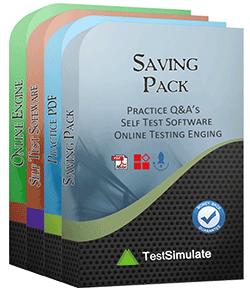
Our Online Test Engine & Self Test Software of TestSimulate 600-212 actual study materials can simulate the exam scene so that you will have a good command of writing speed and time. Then multiple practices make you perfect while in the real Cisco 600-212 exam. The package practice version will not only provide you high-quality 600-212 exam preparation materials but also various studying ways.
100% Money Back Guarantee
TestSimulate has an unprecedented 99.6% first time pass rate among our customers.  We're so confident of our products that we provide no hassle product exchange.
- Best exam practice material
- Three formats are optional
- 10 years of excellence
- 365 Days Free Updates
- Learn anywhere, anytime
- 100% Safe shopping experience
- Instant Download: Our system will send you the products you purchase in mailbox in a minute after payment. (If not received within 12 hours, please contact us. Note: don't forget to check your spam.)
Cisco 600-212 Practice Q&A's

- Printable 600-212 PDF Format
- Prepared by 600-212 Experts
- Instant Access to Download
- Study Anywhere, Anytime
- 365 Days Free Updates
- Free 600-212 PDF Demo Available
- Download Q&A's Demo
Cisco 600-212 Online Engine

- Online Tool, Convenient, easy to study.
- Instant Online Access
- Supports All Web Browsers
- Practice Online Anytime
- Test History and Performance Review
- Supports Windows / Mac / Android / iOS, etc.
- Try Online Engine Demo
Cisco 600-212 Self Test Engine

- Installable Software Application
- Simulates Real Exam Environment
- Builds 600-212 Exam Confidence
- Supports MS Operating System
- Two Modes For Practice
- Practice Offline Anytime
- Software Screenshots
Cisco 600-212 Exam Certification Details:
| Exam Price | $300 USD |
| Exam Name | Implementing Cisco Service Provider Mobility LTE Networks |
| Number of Questions | 65-75 |
| Recommended Training | Implementing Cisco Service Provider Mobility LTE Networks – (SPLTE) |
| Sample Questions | Cisco 600-212 Sample Questions |
| Passing Score | Variable (750-850 / 1000 Approx.) |
| Exam Registration | PEARSON VUE |
| Exam Code | 600-212 SPLTE |
| Duration | 90 minutes |
Cisco 600-212 Exam Topics:
| Section | Weight | Objectives |
|---|---|---|
| SGW (4G LTE) | 10% | 1 Network functions LTE-SGW a) Identify key functions of the SGW and basic understanding of architecture and interfaces b) Describe SGW attach procedures and call flows c) Configure S1-U interface with corresponding services and system parameters d) Configure S5/S8 using PMIP/GTP interface with corresponding services and system parameters e) Configure S11 interface with corresponding services and system parameters 2 Feature functionality and extended application a) Describe multi-PDN support for SGW b) Describe downlink delay notification for SGW c) Describe idle mode signaling reduction support for SGW d) Configure and implement IPV6 support for SGW 3 Internetworking between LTE and other technologies a) Describe interaction with CDMA/eHRPD internetworking b) Describe interaction with GSM/UMTS internetworking c) Configure S4 interface with corresponding services and system parameters d) Configure S12 interface with corresponding services and system parameters e) Configure S103 interface with corresponding services and system parameters 4 Charging a) Configure Gx interface with corresponding services and system parameters 5 QoS a) Describe QoS bearer management and marking for SGW b) Configuring DSCP marking for SGW |
| Lawful Intercept | 5% | 1 Describe lawful intercept architecture and events 2 Configure lawful interception 3 Describe lawful intercept trigger element |
| MME (4G LTE) | 16% | 1 Network functions LTE –MME a) Identify key functions of the MME and basic understanding of architecture and interfaces b) Describe MME states of MM and CM management c) Describe protocol stacks and procedures d) Describe mobility management signaling and call flows e) Describe session management signaling and call flows f) Describe location management signaling and call flows g0 Describe SGS procedures and signaling call flows h) Describe intra-MME handovers procedure i) Describe intra-RAT handovers procedure j) Describe inter-MME handover procedures 2 QOS architecture a) Describe the overall QOS functionality in LTE for single and multi pdn b) Describe the QOS mapping from UMTS to LTE 3 Configurations a) Configure S1 interface with corresponding services and system parameters b) Configure S6a interface with corresponding services and system parameters c) Configure S11 interface with corresponding services and system parameters d) Configure S13 interface with corresponding services and system parameters e) Identify and implement gateway selection mechanisms f) Identify and implement MME operator policy and feature sets g) Troubleshoot configurations 4 Network sharing a) Describe MOCN architecture b) Describe GWCN architecture 5 Security a) Describe LTE security principles for MME network node b) Explain security functions for mobility management procedures 6 Idle mode signaling reduction a) Identify IDLE mode signaling reduction in an LTE network b) Describe IDLE mode signaling establishment c) Describe IDLE mode signaling reduction deactivation 7 CSFB a) Describe CSFB architecture in LTE network b) Describe CSFB call flow and signaling 8 IPv6 support a) Configure IPV6 and dual stack EPS bearer scenarios b) Configure and implement transport plane IPV6 support for MME |
| LTE | 5% | 1 Describe and differentiate LTE / SAE architecture 2 Explain attach procedure and call flow |
| Voice Over LTE | 20% | 1 VoLTE application messages/protocols a) Describe VoLTE specific diameter interface b) Describe XCAP, LDAP, SPML c) Describe CAMEL, CAP, INAP, SOAP, MSML 2 Voice over LTE architecture a) Describe voice evolution in mobile network b) Identify VoLTE system architecture and functions of network elements 3 Network elements in voice over LTE a) Describe CSCF b) Describe ENUM c) Describe MNP — mobile number portability/database d) Describe telephony application server e) Describe DRA/DEA f) Describe HSS g) Describe PCRF h) Describe ATCF,ATGW i) Describe MRF j) Describe understand OSS and BSS 4 QoS a) Describe QoS in EPS b) Describe end-to-end QoS in VoLTE 5 Interfaces and signaling messages a) Configure Gx interface and signaling b) Design Rx interface and signaling c) Implement Cx interface and signaling d) Describe ISC interface and signaling e) Describe Ut interface 6 End-to-end call flow a) Describe IMS client attach to EPC b) Describe P-CSCF discovery c) Describe IMS registration, re-registration and de-registration d) Describe mobile-originated VoLTE call e) Describe mobile-terminated VoLTE call f) Describe emergency VoLTE call 7 Supplementary services a) Describe IR.92 supplementary service overview b) Describe IR.94 supplementary service overview c) Describe Important services call flows 8 VoLTE Interworking a) Describe PSTN interworking b) Describe IMS/SIP interworking c) Describe e-SRVCC |
| PGW (4G LTE/EHRPD) | 15% | 1 Architecture overview a) Identify key functions of the PGW and basic understanding of architecture and interfaces 2 Implement S5/S8 and Gn/Gp interface a) Describe GTP protocol b) Describe mobility management/session management call flows c) Describe QoS in EPC d) Configure S5/S8 interface with corresponding services and system parameters e) Troubleshoot S5/S8 and Gn/Gp 3 APN a) Describe the various IP address allocation mechanisms b) Describe the concept of virtual APNs c) Configure APNs and virtual APNs with corresponding service and system parameters d) Configure IP source address validation and access control list e) Troubleshoot APN 4 Implement Gx interface a) Describe the important diameter AVPs needed for Gx b) Describe basic Gx call flows c) Configure Gx interface with corresponding services and system parameters d) Troubleshoot Gx interface e) Describe the common policy use cases f) Configure failure handling modes g) Configure usage monitoring over Gx 5 Implement Gy interface a) Describe the important diameter AVPs needed for Gy b) Describe the basic Gy call flows c) Configure Gy interface with corresponding services and system parameters d) Troubleshoot Gy interface e) Configure failure handling modes f) Describe OCS selection based on static configuration g) Describe RADIUS attributes and PCRF out-of-quota redirection handling 6 Implement AAA Interface a) Describe the basic AAA authentication and accounting call flows b) Describe the important RADIUS attributes for authentication and accounting c) Configure RADIUS interface with corresponding services and system parameters d) Troubleshoot RADIUS interface 7 Implement S6b interface a) Describe the important diameter AVPs needed for S6b b) Describe the basic S6b call flows c) Configure S6b interface with corresponding services and system parameters d) Troubleshoot S6b interface 8 Interworking with non-3GPP access networks a) Configure S2a interface with corresponding services and system parameters b) Configure S2b interface with corresponding services and system parameters c) Configure S2c interface with corresponding services and system parameters d) Configure LMA functionality on a PGW e) Configure non-3GPP IRAT handovers f) Troubleshoot S2b and S2c interfaces 9 SGi Interface a) Configure and implement various IP transport types b) Configure and implement static and dynamic routing protocols |
| Charging | 13% | 1 Offline charging service a) Describe offline charging architecture b) Explain the GTPP protocol header and messages c) Explain charging data record transport through GTP' d) Compare and contrast GTPP transfer scenarios e) Describe and differentiate mobility records generated by MPC nodes f) Identify and list conditions for record closure and generation g) Explain Rf offline charging scenarios h) Identify and list offline charging error cases i) Configure for offline billing j) Troubleshoot for offline billing |
| Management Protocols | 11% | 1 TACACS a) Describe admin authentication and command authorization methods b) Configure Local administration levels c) Configure external authentication TACACS servers 2 Performance counters/statistics a) Describe the various performance counters b) Describe the collection and processing of performance counters c) Describe the common KPIs for various MPC nodes d) Configure counters and KPIs 3 Fault management a) Describe SNMP protocols, alarms, notification and MIBs b) Configure SNMP traps, filters and thresholds 4 syslog/events Log a) Describe system log formats and filters b) Configure syslog servers and event logs 5 Security a) Describe user access control 6 NTP a) Describe system timing b) Configure NTP servers, system clock, time zone and timestamps |
| Other Interfaces | 5% | 1 AAA/diameter related interfaces a) Describe SWx interface b) Describe S9 interface c) Describe Sp interface 2 HRPD related interfaces a) Describe S101 b) Describe S103 |
As everyone knows that our Cisco 600-212 key content materials with high passing rate can help users clear exam mostly. Our passing rate is reaching to 99.49%. We are a professional website selling professional key content about 600-212 training materials. Through we have PDF version, our main products is selling software products. Most buyers may know that 600-212 test simulates products are more popular: Online Enging version & Self Test Software version which can simulate the real exam scene. If you want to purchase best 600-212 Training Materials, we advise you to choose our test simulate products.
However many examinees may wonder the difference between Online Enging version & Self Test Software version and how to choose the version of 600-212 Test Simulates. Generally speaking, both of them are test engine. Comparing to PDF version which may be printed out and used on paper, these two versions of 600-212 Test Simulates should be used on electronic device. You can not only obtain the key content materials from 600-212 Test Simulates but also keep you good mood by simulating the real test scenes and practicing time after time.
Online Enging version of 600-212 Test Simulates is named as Online enging. As the name suggests, this version should be downloaded and installed on personal computer which should be running on Window and Java System. Some candidates may find 600-212 Test Simulates unavailable after purchasing. Maybe you should download and run Java system. After finishing payment, Online Enging version of 600-212 Test Simulates can be downloaded and installed any computer as you like. Our software does not have limits for the quantity of computer and the loading time you will load in. Also after downloading and installing, you can copy 600-212 Test Simulates to any other device as you like and use it offline.
Self Test Software version of 600-212 Test Simulates can simulate the real test scenes like Online enging version. The difference from Online enging is that it can be used on any device because it is operating based on web browser. If you are Mac computer or if you want to use on Mobile phone or IPad, you should choose Self Test Software version of 600-212 Test Simulates. Normally it should be operating online for the first time, if you do not clear cache, you can prepare 600-212 Key Content offline the second times.
The test engine is a progressive study tool which is useful and convenient for learners so that our 600-212 test simulates is acceptable for most buyers. Of course, if you get used to studying on paper, PDF version has same key contest materials of 600-212. Besides, we provide excellent before-sale and after-sale service support for all learners who are interested in our 600-212 training materials. 7*24*365 online service: you don't need to worry about time difference or different holidays as our customers are from all over the world. You can always get our support aid in time. If you want to know more service terms about Cisco 600-212 Key Content materials like our "365 Days Free Updates Download" and "Money Back Guaranteed", we are pleased to hear from you any time.
 Brandon
Daniel
Fitch
Hugh
Larry
Mortimer
Isaac
TestSimulate is the world's largest certification preparation company with 99.6% Pass Rate History from 73306+ Satisfied Customers in 148 Countries.

Over 73306+ Satisfied Customers