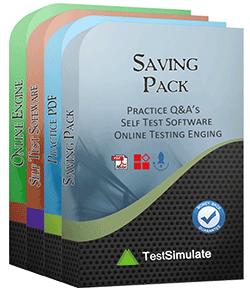
Download Cisco : 600-211 Questions & Answers as PDF & Test Software
Last Updated: Jun 14, 2026
No. of Questions: 70 Questions & Answers with Testing Engine
Download Limit: Unlimited
Reliable & Actual Study Materials for 600-211 Exam Success
Our Online Test Engine & Self Test Software of TestSimulate 600-211 actual study materials can simulate the exam scene so that you will have a good command of writing speed and time. Then multiple practices make you perfect while in the real Cisco 600-211 exam. The package practice version will not only provide you high-quality 600-211 exam preparation materials but also various studying ways.
100% Money Back Guarantee
TestSimulate has an unprecedented 99.6% first time pass rate among our customers.  We're so confident of our products that we provide no hassle product exchange.
- Best exam practice material
- Three formats are optional
- 10 years of excellence
- 365 Days Free Updates
- Learn anywhere, anytime
- 100% Safe shopping experience
- Instant Download: Our system will send you the products you purchase in mailbox in a minute after payment. (If not received within 12 hours, please contact us. Note: don't forget to check your spam.)
Cisco 600-211 Practice Q&A's

- Printable 600-211 PDF Format
- Prepared by 600-211 Experts
- Instant Access to Download
- Study Anywhere, Anytime
- 365 Days Free Updates
- Free 600-211 PDF Demo Available
- Download Q&A's Demo
Cisco 600-211 Online Engine

- Online Tool, Convenient, easy to study.
- Instant Online Access
- Supports All Web Browsers
- Practice Online Anytime
- Test History and Performance Review
- Supports Windows / Mac / Android / iOS, etc.
- Try Online Engine Demo
Cisco 600-211 Self Test Engine

- Installable Software Application
- Simulates Real Exam Environment
- Builds 600-211 Exam Confidence
- Supports MS Operating System
- Two Modes For Practice
- Practice Offline Anytime
- Software Screenshots
Cisco 600-211 Exam Certification Details:
| Exam Registration | PEARSON VUE |
| Exam Price | $300 USD |
| Duration | 90 minutes |
| Passing Score | Variable (750-850 / 1000 Approx.) |
| Recommended Training | Implementing Cisco Service Provider Mobility CDMA Networks – (SPCDMA) |
| Exam Name | Implementing Cisco Service Provider Mobility CDMA Networks |
| Exam Code | 600-211 SPCDMA |
| Sample Questions | Cisco 600-211 Sample Questions |
| Number of Questions | 65-75 |
Cisco 600-211 Exam Topics:
| Section | Weight | Objectives |
|---|---|---|
| PDSN/Foreign Agent (3G CDMA node) | 13% | 1 Network functions PDSN a) Describe the PDSN architecture and interfaces b) Describe IPv4 address allocation to UE for Simple IP c) Configure SIP/PMIP/MIP 2 Authentication and Authorization a) Configure and implement RADIUS authentication and authorization 3 Accounting and Charging a) Configure and implement RADIUS accounting b) Configure and implement the enhanced charging service c) Configure and implement EDR/UDR 4 Configure and implement RP interfaces to RNC/PCF |
| Diameter (MPC centric) | 11% | 1 Define and understand diameter base protocol 2 Understand transport layer functionality of diameter protocol 3 Understand and implement diameter routing agents 4 Understand diameter peer discovery 5 Understanding diameter message processing 6 Understanding diameter error handling mechanism 7 Describe and understand diameter re-authorization procedure 8 Describe and understand DCCA model |
| Home Agent (3G CDMA) | 11% | 1 Network functions HA a) Describe the HA architecture and interfaces b) Describe the IPv4 and IPv6 address allocation to UE c) Explain the basic functions of EVDO-RevA QoS 2 Authentication and Authorization a) Configure and implement RADIUS authentication and authorization 3 Accounting and Charging a) Configure and implement RADIUS Accounting b) Configure and implement Online Charging (OCS) via Gy interface c) Configure and implement Offline Charging (OFCS) via Rf/Ga interface d) Configure and implement the Enhanced Charging Service e) Configure and implement EDR/UDR f) Configure and implement policy and charging control via Gx interface 4 SGi Termination a) Configure and implement various tunneling GRE, IP-in-IP, IPSec |
| MIP/Proxy MIP/Simple IP | 9% | 1 Simple IP a) Describe Simple IP protocol and interfaces 2 Mobile IP a) Describe Mobile IP protocol and interfaces b) Describe Mobile IP registration/registration revocation c) Describe MIPv4 in foreign agent mode 3 Proxy MIP a) Describe proxy MIPv6 protocol and interfaces b) Describe dual stack mobile IPv6 protocol and interfaces c) Describe integration with LTE networks |
| Tunneling Protocols | 12% | 1 Basics of tunneling and encryption a) Identify application of tunneling in wireless data networks 2 Generic Routing Encapsulation (GRE) a) Identify applications of GRE in wireless data networks b) Configure GRE tunnels c) Troubleshoot GRE tunnels 3 Layer 2 Tunneling Protocol (L2TP) a) Identify applications of l2TP in wireless data networks b) Describe LNS selection and load balancing c) Describe L2TP over IPSec d) Configuring L2TP tunnels e) Troubleshoot L2TP tunnels 4 Internet Protocol Security (IPsec) a) Configure IPSec tunnels on the GGSN b) Identify applications of IPSec tunnels as applied to mobile wireless networks c) Describe IPSec for IPv6 d) Troubleshoot IPSec 5 MPLS over BGP a) Describe MPLS over BGP in mobile packet core networks b) Configure MPLS over BGP c) Troubleshoot MPLS over BGP |
| Inline Services | 20% | 1 Packet Inspection a) Explain common L7 applications b) Describe packet processing by the traffic inspection engine c) Describe and configuration of rules to be used for traffic inspection d) Describe and configuration of the charging rules e) Configure charging policies f) Design and configuration of rule bases, and designs the priorities for the rules and their corresponding charging policies g) Describe Handling of VOIP traffic h) Configure post processing rules i) Troubleshoot packet Inspection 2 P2P Detection a) Configure the rules for the various P2P applications b) Describe mechanism of updating the software to detect newer P2P applications 3 Content Filtering a) Describe the various content filtering mechanisms available b) Describe ICAP protocol c) Configure content filtering d) Troubleshoot content filtering 4 Firewall Policies a) Describe the basics of stateful attacks b) Configure access rules c) Troubleshoot firewall policies 5 NAT a) Configure NAT IP Pools and Port Chunk Groups to be used b) Configure the NAT accounting records c) Troubleshoot NAT 6 Event Based Charging a) Configure Event Data Records (EDRs) b) Configuration flow based charging records (Enhanced GCDR Records) c) Describe report generation using EDRs for different types 7 Fraud Detection a) Describe DNS snooping b) Explain the various mechanisms available for detection of tethered traffic c) Describe updating the database for the list of known tethered devices d) Configure fraud detection e) Troubleshoot fraud detection 8 HTTP Header Enrichment a) Describe HTTP header enrichment b) Configure HTTP header enrichment c) Troubleshoot HTTP header enrichment |
| HSGW (4G EHRPD node) | 20% | 1 Network functions HSGW a) Basic understanding of HSGW architecture and interfaces b) Basic understanding of HSGW call flows MIP/PMIP/QoS c) Basic understanding of MAG service on HSGW d) Basic understanding of LMA service on PGW e) Basic understanding of PGW selection f) Optimized and non-optimized handover between 3GPP and non-3GPP 2 Authentication and Authorization a) Configure and implement STa diameter authentication and authorization 3 Accounting and Charging a) Configure and implement Online charging (OCS) via Gy interface b) Configure and implement Offline charging (OFCS) 4 Policy a) Configure and implement policy via Gxa interface 5 Radio Network Interface a) Configure and implement RP interfaces to eRNC |
| CDMA | 4% | 1 Identify key functions of CDMA and basic understanding of architecture and interfaces 2 Describe the attach procedure and call flow |
As everyone knows that our Cisco 600-211 key content materials with high passing rate can help users clear exam mostly. Our passing rate is reaching to 99.49%. We are a professional website selling professional key content about 600-211 training materials. Through we have PDF version, our main products is selling software products. Most buyers may know that 600-211 test simulates products are more popular: Online Enging version & Self Test Software version which can simulate the real exam scene. If you want to purchase best 600-211 Training Materials, we advise you to choose our test simulate products.
However many examinees may wonder the difference between Online Enging version & Self Test Software version and how to choose the version of 600-211 Test Simulates. Generally speaking, both of them are test engine. Comparing to PDF version which may be printed out and used on paper, these two versions of 600-211 Test Simulates should be used on electronic device. You can not only obtain the key content materials from 600-211 Test Simulates but also keep you good mood by simulating the real test scenes and practicing time after time.
Online Enging version of 600-211 Test Simulates is named as Online enging. As the name suggests, this version should be downloaded and installed on personal computer which should be running on Window and Java System. Some candidates may find 600-211 Test Simulates unavailable after purchasing. Maybe you should download and run Java system. After finishing payment, Online Enging version of 600-211 Test Simulates can be downloaded and installed any computer as you like. Our software does not have limits for the quantity of computer and the loading time you will load in. Also after downloading and installing, you can copy 600-211 Test Simulates to any other device as you like and use it offline.
Self Test Software version of 600-211 Test Simulates can simulate the real test scenes like Online enging version. The difference from Online enging is that it can be used on any device because it is operating based on web browser. If you are Mac computer or if you want to use on Mobile phone or IPad, you should choose Self Test Software version of 600-211 Test Simulates. Normally it should be operating online for the first time, if you do not clear cache, you can prepare 600-211 Key Content offline the second times.
The test engine is a progressive study tool which is useful and convenient for learners so that our 600-211 test simulates is acceptable for most buyers. Of course, if you get used to studying on paper, PDF version has same key contest materials of 600-211. Besides, we provide excellent before-sale and after-sale service support for all learners who are interested in our 600-211 training materials. 7*24*365 online service: you don't need to worry about time difference or different holidays as our customers are from all over the world. You can always get our support aid in time. If you want to know more service terms about Cisco 600-211 Key Content materials like our "365 Days Free Updates Download" and "Money Back Guaranteed", we are pleased to hear from you any time.
 Bennett
Chasel
Eden
Grover
Jim
Mark
Harold
TestSimulate is the world's largest certification preparation company with 99.6% Pass Rate History from 73408+ Satisfied Customers in 148 Countries.

Over 73408+ Satisfied Customers