Download CompTIA : SY0-401 Questions & Answers as PDF & Test Software
Last Updated: Jun 04, 2026
No. of Questions: 1790 Questions & Answers with Testing Engine
Download Limit: Unlimited
Reliable & Actual Study Materials for SY0-401 Exam Success
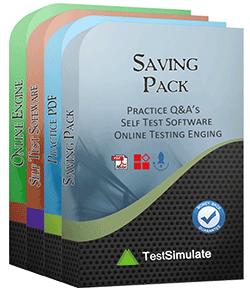
Our Online Test Engine & Self Test Software of TestSimulate SY0-401 actual study materials can simulate the exam scene so that you will have a good command of writing speed and time. Then multiple practices make you perfect while in the real CompTIA SY0-401 exam. The package practice version will not only provide you high-quality SY0-401 exam preparation materials but also various studying ways.
100% Money Back Guarantee
TestSimulate has an unprecedented 99.6% first time pass rate among our customers.  We're so confident of our products that we provide no hassle product exchange.
- Best exam practice material
- Three formats are optional
- 10 years of excellence
- 365 Days Free Updates
- Learn anywhere, anytime
- 100% Safe shopping experience
- Instant Download: Our system will send you the products you purchase in mailbox in a minute after payment. (If not received within 12 hours, please contact us. Note: don't forget to check your spam.)
CompTIA SY0-401 Practice Q&A's

- Printable SY0-401 PDF Format
- Prepared by SY0-401 Experts
- Instant Access to Download
- Study Anywhere, Anytime
- 365 Days Free Updates
- Free SY0-401 PDF Demo Available
- Download Q&A's Demo
CompTIA SY0-401 Online Engine

- Online Tool, Convenient, easy to study.
- Instant Online Access
- Supports All Web Browsers
- Practice Online Anytime
- Test History and Performance Review
- Supports Windows / Mac / Android / iOS, etc.
- Try Online Engine Demo
CompTIA SY0-401 Self Test Engine

- Installable Software Application
- Simulates Real Exam Environment
- Builds SY0-401 Exam Confidence
- Supports MS Operating System
- Two Modes For Practice
- Practice Offline Anytime
- Software Screenshots
We have introduced too much details about our SY0-401 test simulates: CompTIA Security+ Certification on the other page about Self Test Software & Online Enging. If learners are interested in our SY0-401 study guide and hard to distinguish, we are pleased to tell you alone. Below we will focus on your benefits if you become our users.
Firstly, we want to stress that our SY0-401 test simulates: CompTIA Security+ Certification are valid as we are researching CompTIA exams many years. Most our experts are experienced and familiar with the real questions in past ten years. We know the key knowledge materials about SY0-401 exam so that we can always compile valid exam study guide. We are skilled at CompTIA exams with so many years' development. We have stable & high passing rate for CompTIA exams recent years. If you pay attention on our exam study guide after purchasing, you should not worry too much, our products will assist you to clear exam easily. We will assist you to prepare well until you pass exam.
Secondly, our products are high-quality. Our value is obvious to all:
1. PDF version of SY0-401 study guide is available for you to print out and note your studying thoughts on paper. Self Test Software and Online Enging of SY0-401 study guide have simulation functions which is not only easy for you to master our questions and answers better but also make you familiar with exam mood so that you will be confident.
2. Our SY0-401 test simulates materials make you do sharp and better target preparation for your real exam. This ways will cut off your preparation time. Your learning will be proficient.
3. One-shot pass with help of our SY0-401 test simulates materials will make you save a lot of time and energy. As exam fee is expensive, you may not want to pay twice or more.
4. 365 Days Free Updates Download: you will not miss our valid SY0-401 study guide, and also you don't have to worry about your exam plan. One year is enough for you to do everything.
Thirdly, About Payment & Refund: we only support Credit Card for most countries. Our purchasing procedure of SY0-401 test simulates materials is surely safe. If you find any unusual or extra tax & fee please contact us soon. Our promise is "Money Back Guaranteed". Please rest assured. We are legal authoritative company. If you fail exam unluckily and apply for refund, we will refund to you soon. You are not allowed to waste one penny on useless products.
Fourthly, About Discount: as we put into much money on information resources and R&D, all our experts are highly educated and skilled so that our SY0-401 test simulates materials receive recognition with its high pass-rate from peers and users. Our price is really reasonable. If you really want some discount, you can pay attention on holiday activities. Or if you are regular customers and introduce our SY0-401 study guide to others we will give you some discount.
CompTIA Security+ Exam Certification Details:
| Exam Code | SY0-401 |
| Number of Questions | 90 |
| Passing Score | 750 / 900 |
| Exam Price | $330 (USD) |
| Sample Questions | CompTIA Security+ Sample Questions |
| Exam Name | CompTIA Security+ |
| Duration | 90 mins |
| Books / Training | CompTIA CertMaster for Security+ |
| Schedule Exam | CompTIA Marketplace |
Reference: https://certification.comptia.org/certifications/security
CompTIA SY0-401 Exam Syllabus Topics:
| Topic | Details |
|---|---|
| Network Security 20% | |
| Implement security configuration parameters on network devices and other technologies. | 1.Firewalls 2.Routers 3.Switches 4.Load balancers 5.Proxies 6.Web security gateways 7.VPN concentrators 8.NIDS and NIPS
10.Spam filter 11.UTM security appliances
13.Application aware devices
|
| Given a scenario, use secure network administration principles. | 1. Rule-based management2. Firewall rules 2.VLAN management 3. Secure router configuration 4. Access control lists 5. Port security 6. 802.1x 7. Flood guards 8. Loop protection 9. Implicit deny 10. Network separation 11. Log analysis 12. Unified threat management |
| Explain network design elements and components. | 1.DMZ 2. Subnetting 3.VLAN 4.NAT 5.Remote access 6.Telephony 7.NAC 8.Virtualization 9.Cloud computing
|
| Given a scenario, implement common protocols and services. | 1.Protocols
|
| Given a scenario, troubleshoot security issues related to wireless networking. | 1. WPA2. WPA2 3.WEP 4. EAP 5. PEAP 6. LEAP 7. MAC filter 8. Disable SSID broadcast 9. TKIP 10. CCMP 11. Antenna placement 12. Power level controls 13. Captive portals 14. Antenna types 15. Site surveys 16. VPN (over open wireless) |
| Compliance and Operational Security 18% | |
| Explain the importance of risk related concepts. | 1.Control types
3.False negatives 4.Importance of policies in reducing riskPrivacy policy Acceptable use Security policy Mandatory vacations Job rotation Separation of duties Least privilege 5.Risk calculation
7.Vulnerabilities 8.Threat vectors 9.Probability/threat likelihood 10. Risk avoidance, transference, acceptance, mitigation, deterrence 11. Risks associated with cloud computing and virtualization 12. Recovery time objective and recovery point objective |
| Summarize the security implications of integrating systems and data with third parties. | 1. On-boarding/off-boarding business partners 2.Social media networks and/or applications 3.Interoperability agreements
5. Risk awareness 6. Unauthorized data sharing 7. Data ownership 8. Data backups 9. Follow security policy and procedures 10. Review agreement requirements to verify compliance and performance standards |
| Given a scenario, implement appropriate risk mitigation strategies. | 1. Change management2. Incident management 3. User rights and permissions reviews 4. Perform routine audits 5. Enforce policies and procedures to prevent data loss or theft 6.Enforce technology controls
|
| Given a scenario, implement basic forensic procedures. | 1. Order of volatility2. Capture system image 3. Network traffic and logs 4. Capture video 5. Record time offset 6. Take hashes 7. Screenshots 8. Witnesses 9. Track man hours and expense 10. Chain of custody 11. Big Data analysis |
| Summarize common incident response procedures. | 1. Preparation2. Incident identification 3. Escalation and notification 4. Mitigation steps 5. Lessons learned 6. Reporting 7.Recovery/reconstitution procedures 8.First responder 9. Incident isolation
11.Damage and loss control |
| Explain the importance of security related awareness and training. | 1.Security policy training and procedures 2.Role-based training 3.Personally identifiable information 4.Information classification
6. Compliance with laws, best practices and standards 7.User habits
10. Follow up and gather training metrics to validate compliance and security posture |
| Compare and contrast physical security and environmental controls. | 1.Environmental controls
|
| Summarize risk management best practices. | 1.Business continuity concepts
|
| Given a scenario, select the appropriate control to meet the goals of security. | 1.Confidentiality
|
| Threats and Vulnerabilities 20% | |
| Explain types of malware. | 1. Adware2. Virus 3. Spyware 4. Trojan 5. Rootkits 6. Backdoors 7. Logic bomb 8. Botnets 9.Ransomware 10. Polymorphic malware 11. Armored virus |
| Summarize various types of attacks. | 1. Man-in-the-middle2. DDoS 3. DoS 4. Replay 5. Smurf attack 6. Spoofing 7. Spam 8. Phishing 9.Spim 10. Vishing 11. Spear phishing 12. Xmas attack 13.Pharming 14. Privilege escalation 15. Malicious insider threat 16. DNS poisoning and ARP poisoning 17 Transitive access 18. Client-side attacks 19.Password attacks
21.Watering hole attack |
| Summarize social engineering attacks and the associated effectiveness with each attack. | 1. Shoulder surfing2. Dumpster diving 3. Tailgating 4. Impersonation 5. Hoaxes 6.Whaling 7.Vishing 8.Principles (reasons for effectiveness)
|
| Explain types of wireless attacks. | 1. Rogue access points2. Jamming/interference 3. Evil twin 4. War driving 5. Bluejacking 6. Bluesnarfing 7. War chalking 8. IV attack 9. Packet sniffing 10. Near field communication 11. Replay attacks 12.WEP/WPA attacks 13.WPS attacks |
| Explain types of application attacks. | 1. Cross-site scripting2. SQL injection 3.LDAP injection 4. XML injection 5. Directory traversal/command injection 6. Buffer overflow 7. Integer overflow 8. Zero-day 9. Cookies and attachments 10. Locally Shared Objects (LSOs) 11. Flash cookies 12. Malicious add-ons 13. Session hijacking 14. Header manipulation 15. Arbitrary code execution/remote code execution |
| Analyze a scenario and select the appropriate type of mitigation and deterrent techniques. | 1.Monitoring system logs
|
| Given a scenario, use appropriate tools and techniques to discover security threats and vulnerabilities. | 1. Interpret results of security assessment tools 2.Tools
|
| Explain the proper use of penetration testing versus vulnerability scanning. | 1.Penetration testing
4. White box 5.Gray box |
| Application, Data and Host Security 15% | |
| Explain the importance of application security controls and techniques. | 1.Fuzzing 2.Secure coding concepts
4. Cross-site Request Forgery (XSRF) prevention 5. Application configuration baseline (proper settings) 6. Application hardening 7. Application patch management 8. NoSQL databases vs. SQL databases 9. Server-side vs. client-side validation |
| Summarize mobile security concepts and technologies. | 1.Device security
|
| Given a scenario, select the appropriate solution to establish host security. | 1. Operating system security and settings 2.OS hardening 3.Anti-malware
5. Whitelisting vs. blacklisting applications 6. Trusted OS 7. Host-based firewalls 8. Host-based intrusion detection 9. Hardware security
11.Virtualization
|
| Implement the appropriate controls to ensure data security. | 1. Cloud storage2. SAN 3. Handling Big Data 4. Data encryption
7. Permissions/ACL 8.Data policies
|
| Compare and contrast alternative methods to mitigate security risks in static environments. | 1.Environments
|
| Access Control and Identity Management 15% | |
| Compare and contrast the function and purpose of authentication services. | 1. RADIUS2. TACACS+ 3.Kerberos 4.LDAP 5. XTACACS 6. SAML 7. Secure LDAP |
| Given a scenario, select the appropriate authentication, authorization or access control. | 1. Identification vs. authentication vs. authorization2. Authorization
7.Transitive trust/authentication |
| Install and configure security controls when performing account management, based on best practices. | 1. Mitigate issues associated with users with multiple account/ roles and/or shared accounts 2.Account policy enforcement
4. User-assigned privileges 5. User access reviews 6. Continuous monitoring |
| Cryptography 12% | |
| Given a scenario, utilize general cryptography concepts. | 1. Symmetric vs. asymmetric2. Session keys 3. In-band vs. out-of-band key exchange 4. Fundamental differences and encryption methods
6. Non-repudiation 7. Hashing 8. Key escrow 9. Steganography 10. Digital signatures11. Use of proven technologies 12. Elliptic curve and quantum cryptography 13. Ephemeral key 14. Perfect forward secrecy |
| Given a scenario, use appropriate cryptographic methods. | 1. WEP vs. WPA/WPA2 and pre-shared key2. MD5 3.SHA 4.RIPEMD 5. AES 6. DES 7.3DES 8.HMAC 9. RSA 10.Diffie-Hellman 11.RC4 12. One-time pads 13. NTLM 14.NTLMv2 15. Blowfish 16. PGP/GPG 17. Twofish 18. DHE 19. ECDHE 20. CHAP 21. PAP 22. Comparative strengths and performance of algorithms 23. Use of algorithms/protocols with transport encryption
|
| Given a scenario, use appropriate PKI, certificate management and associated components. | 1. Certificate authorities and digital certificates
3. Recovery agent 4. Public key 5. Private key 6. Registration 7. Key escrow 8. Trust models |
Over 73359+ Satisfied Customers

 Wright
Betsy
Dora
Griselda
Kama
Megan
Phoebe
TestSimulate is the world's largest certification preparation company with 99.6% Pass Rate History from 73359+ Satisfied Customers in 148 Countries.