Download Cisco : 400-251 Questions & Answers as PDF & Test Software
Last Updated: May 30, 2026
No. of Questions: 125 Questions & Answers with Testing Engine
Download Limit: Unlimited
Reliable & Actual Study Materials for 400-251 Exam Success
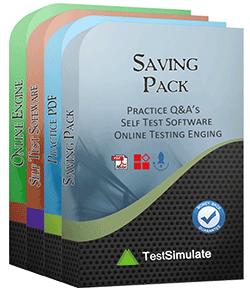
Our Online Test Engine & Self Test Software of TestSimulate 400-251 actual study materials can simulate the exam scene so that you will have a good command of writing speed and time. Then multiple practices make you perfect while in the real Cisco 400-251 exam. The package practice version will not only provide you high-quality 400-251 exam preparation materials but also various studying ways.
100% Money Back Guarantee
TestSimulate has an unprecedented 99.6% first time pass rate among our customers.  We're so confident of our products that we provide no hassle product exchange.
- Best exam practice material
- Three formats are optional
- 10 years of excellence
- 365 Days Free Updates
- Learn anywhere, anytime
- 100% Safe shopping experience
- Instant Download: Our system will send you the products you purchase in mailbox in a minute after payment. (If not received within 12 hours, please contact us. Note: don't forget to check your spam.)
Cisco 400-251 Practice Q&A's

- Printable 400-251 PDF Format
- Prepared by 400-251 Experts
- Instant Access to Download
- Study Anywhere, Anytime
- 365 Days Free Updates
- Free 400-251 PDF Demo Available
- Download Q&A's Demo
Cisco 400-251 Online Engine

- Online Tool, Convenient, easy to study.
- Instant Online Access
- Supports All Web Browsers
- Practice Online Anytime
- Test History and Performance Review
- Supports Windows / Mac / Android / iOS, etc.
- Try Online Engine Demo
Cisco 400-251 Self Test Engine

- Installable Software Application
- Simulates Real Exam Environment
- Builds 400-251 Exam Confidence
- Supports MS Operating System
- Two Modes For Practice
- Practice Offline Anytime
- Software Screenshots
We have introduced too much details about our 400-251 test simulates: CCIE Security Written Exam (v5.0) on the other page about Self Test Software & Online Enging. If learners are interested in our 400-251 study guide and hard to distinguish, we are pleased to tell you alone. Below we will focus on your benefits if you become our users.
Firstly, we want to stress that our 400-251 test simulates: CCIE Security Written Exam (v5.0) are valid as we are researching Cisco exams many years. Most our experts are experienced and familiar with the real questions in past ten years. We know the key knowledge materials about 400-251 exam so that we can always compile valid exam study guide. We are skilled at Cisco exams with so many years' development. We have stable & high passing rate for Cisco exams recent years. If you pay attention on our exam study guide after purchasing, you should not worry too much, our products will assist you to clear exam easily. We will assist you to prepare well until you pass exam.
Secondly, our products are high-quality. Our value is obvious to all:
1. PDF version of 400-251 study guide is available for you to print out and note your studying thoughts on paper. Self Test Software and Online Enging of 400-251 study guide have simulation functions which is not only easy for you to master our questions and answers better but also make you familiar with exam mood so that you will be confident.
2. Our 400-251 test simulates materials make you do sharp and better target preparation for your real exam. This ways will cut off your preparation time. Your learning will be proficient.
3. One-shot pass with help of our 400-251 test simulates materials will make you save a lot of time and energy. As exam fee is expensive, you may not want to pay twice or more.
4. 365 Days Free Updates Download: you will not miss our valid 400-251 study guide, and also you don't have to worry about your exam plan. One year is enough for you to do everything.
Thirdly, About Payment & Refund: we only support Credit Card for most countries. Our purchasing procedure of 400-251 test simulates materials is surely safe. If you find any unusual or extra tax & fee please contact us soon. Our promise is "Money Back Guaranteed". Please rest assured. We are legal authoritative company. If you fail exam unluckily and apply for refund, we will refund to you soon. You are not allowed to waste one penny on useless products.
Fourthly, About Discount: as we put into much money on information resources and R&D, all our experts are highly educated and skilled so that our 400-251 test simulates materials receive recognition with its high pass-rate from peers and users. Our price is really reasonable. If you really want some discount, you can pay attention on holiday activities. Or if you are regular customers and introduce our 400-251 study guide to others we will give you some discount.
Cisco 400-251 Exam Certification Details:
| Exam Price | $450 USD |
| Exam Code | 400-251 CCIE S |
| Exam Name | CCIE Security Written Exam |
| Passing Score | Variable (750-850 / 1000 Approx.) |
| Duration | 120 minutes |
| Exam Registration | PEARSON VUE |
| Number of Questions | 90-110 |
| Sample Questions | Cisco 400-251 Sample Questions |
Cisco 400-251 Exam Topics:
| Section | Weight Written | Weight Lab | Objectives |
|---|---|---|---|
| Advanced Threat Protection and Content Security | 17% | 19% | 1 Compare and contrast different AMP solutions including public and private cloud deployment models 2 Describe, implement, and troubleshoot AMP for networks, AMP for endpoints, and AMP for content security (CWS, ESA, and WSA) 3 Detect, analyze, and mitigate malware incidents 4 Describe the benefit of threat intelligence provided by AMP Threat GRID 5 Perform packet capture and analysis using Wireshark, tcpdump, SPAN, and RSPAN 6 Describe, implement, and troubleshoot web filtering, user identification, and Application Visibility and Control (AVC) 7 Describe, implement, and troubleshoot mail policies, DLP, email quarantines, and SenderBase on ESA 8 Describe, implement, and troubleshoot SMTP authentication such as SPF and DKIM on ESA 9 Describe, implement, and troubleshoot SMTP encryption on ESA 10 Compare and contrast different LDAP query types on ESA 11 Describe, implement, and troubleshoot WCCP redirection 12 Compare and contrast different proxy methods such as SOCKS, Auto proxy/WPAD, and transparent 13 Describe, implement, and troubleshoot HTTPS decryption and DLP 14 Describe, implement, and troubleshoot CWS connectors on Cisco IOS routers, Cisco ASA, Cisco AnyConnect, and WSA 15 Describe the security benefits of leveraging the OpenDNS solution. 16 Describe, implement, and troubleshoot SMA for centralized content security management 17 Describe the security benefits of leveraging Lancope |
| Identity Management, Information Exchange, and Access Control | 22% | 24% | 1 Describe, implement, and troubleshoot various personas of ISE in a multinode deployment 2 Describe, implement, and troubleshoot network access device (NAD), ISE, and ACS configuration for AAA 3 Describe, implement, and troubleshoot AAA for administrative access to Cisco network devices using ISE and ACS 4 Describe, implement, verify, and troubleshoot AAA for network access with 802.1X and MAB using ISE. 5 Describe, implement, verify, and troubleshoot cut-through proxy/auth-proxy using ISE as the AAA server 6 Describe, implement, verify, and troubleshoot guest life cycle management using ISE and Cisco network infrastructure 7 Describe, implement, verify, and troubleshoot BYOD on-boarding and network access flows with an internal or external CA 8 Describe, implement, verify, and troubleshoot ISE and ACS integration with external identity sources such as LDAP, AD, and external RADIUS 9 Describe ISE and ACS integration with external identity sources such as RADIUS Token, RSA SecurID, and SAML 10 Describe, implement, verify, and troubleshoot provisioning of AnyConnect with ISE and ASA 11 Describe, implement, verify, and troubleshoot posture assessment with ISE 12 Describe, implement, verify, and troubleshoot endpoint profiling using ISE and Cisco network infrastructure including device sensor 13 Describe, implement, verify, and troubleshoot integration of MDM with ISE 14 Describe, implement, verify, and troubleshoot certificate based authentication using ISE 15 Describe, implement, verify, and troubleshoot authentication methods such as EAPChaining and Machine Access Restriction (MAR) 16 Describe the functions and security implications of AAA protocols such as RADIUS, TACACS+, LDAP/LDAPS, EAP (EAP-PEAP, EAP-TLS, EAP-TTLS, EAP-FAST, EAP-TEAP, EAP- MD5, EAP-GTC), PAP, CHAP, and MS-CHAPv2 17 Describe, implement, and troubleshoot identity mapping on ASA, ISE, WSA and FirePOWER 18 Describe, implement, and troubleshoot pxGrid between security devices such as WSA, ISE, and Cisco FMC |
| Evolving Technologies v1.1 | 10% | N/A | 1 Cloud a) Compare and contrast Cloud deployment models a) [i] Infrastructure, platform, and software services (XaaS) a) [ii] Performance and reliability a) [iii] Security and privacy a) [iv] Scalability and interoperability b) Describe Cloud implementations and operations b) [i] Automation and orchestration b) [ii] Workload mobility b) [iii] Troubleshooting and management b) [iv] OpenStack components 2 Network Programmability (SDN) a) Describe functional elements of network programmability (SDN) and how they interact a) [i] Controllers a) [ii] APIs a) [iii] Scripting a) [iv] Agents a) [v] Northbound vs. Southbound protocols b) Describe aspects of virtualization and automation in network environments b) [i] DevOps methodologies, tools and workflows b) [ii] Network/application function virtualization (NFV, AFV) b) [iii] Service function chaining b) [iv] Performance, availability, and scaling considerations 3 Internet of Things (IoT) a) Describe architectural framework and deployment considerations for Internet of Things a) [i] Performance, reliability and scalability a) [ii] Mobility a) [iii] Security and privacy a) [iv] Standards and compliance a) [v] Migration a) [vi] Environmental impacts on the network |
| Infrastructure Security, Virtualization, and Automation | 13% | 15% | 1 Identify common attacks such as Smurf, VLAN hopping, and SYNful knock, and their mitigation techniques 2 Describe, implement, and troubleshoot device hardening techniques and control plane protection methods, such as CoPP and IP Source routing. 3 Describe, implement, and troubleshoot management plane protection techniques such as CPU and memory thresholding and securing device access 4 Describe, implement, and troubleshoot data plane protection techniques such as iACLs, uRPF, QoS, and RTBH 5 Describe, implement, and troubleshoot IPv4/v6 routing protocols security 6 Describe, implement, and troubleshoot Layer 2 security techniques such as DAI, IPDT, STP security, port security, DHCP snooping, and VACL 7 Describe, implement, and troubleshoot wireless security technologies such as WPA, WPA2, TKIP, and AES 8 Describe wireless security concepts such as FLEX Connect, wIPS, ANCHOR, Rogue AP, and Management Frame Protection (MFP) 9 Describe, implement, and troubleshoot monitoring protocols such as NETFLOW/IPFIX, SNMP, SYSLOG, RMON, NSEL, and eSTREAMER 10 Describe the functions and security implications of application protocols such as SSH, TELNET, TFTP, HTTP/HTTPS, SCP, SFTP/FTP, PGP, DNS/DNSSEC, NTP, and DHCP 11 Describe the functions and security implications of network protocols such as VTP, 802.1Q, TCP/UDP, CDP, LACP/PAgP, BGP, EIGRP, OSPF/OSPFv3, RIP/RIPng, IGMP/CGMP, PIM, IPv6, and WCCP 12 Describe the benefits of virtualizing security functions in the data center using ASAv, WSAv, ESAv, and NGIPSv 13 Describe the security principles of ACI such as object models, endpoint groups, policy enforcement, application network profiles, and contracts 14 Describe the northbound and southbound APIs of SDN controllers such as APIC-EM 15 Identify and implement security features to comply with organizational security policies, procedures, and standards such as BCP 38, ISO 27001, RFC 827, and PCI-DSS 16 Describe and identify key threats to different places in the network (campus, data center, core, edge) as described in Cisco SAFE 17 Validate network security design for adherence to Cisco SAFE recommended practices 18 Interpret basic scripts that can retrieve and send data using RESTful API calls in scripting languages such as Python 19 Describe Cisco Digital Network Architecture (DNA) principles and components. |
| Secure Connectivity and Segmentation | 17% | 19% | 1 Compare and contrast cryptographic and hash algorithms such as AES, DES, 3DES, ECC, SHA, and MD5 2 Compare and contrast security protocols such as ISAKMP/IKEv1, IKEv2, SSL, TLS/DTLS, ESP, AH, SAP, and MKA 3 Describe, implementc and troubleshoot remote access VPN using technologies such as FLEXVPN, SSL-VPN between Cisco firewalls, routers, and end hosts 4 Describe, implement, and troubleshoot the Cisco IOS CA for VPN authentication 5 Describe, implement, and troubleshoot clientless SSL VPN technologies with DAP and smart tunnels on Cisco ASA and Cisco FTD 6 Describe, implement, and troubleshoot site-to-site VPNs such as GETVPN, DMVPN and IPsec 7 Describe, implement, and troubleshoot uplink and downlink MACsec (802.1AE) 8 Describe, implement, and troubleshoot VPN high availability using Cisco ASA VPN clustering and dual-hub DMVPN deployments 9 Describe the functions and security implications of cryptographic protocols such as AES, DES, 3DES, ECC, SHA, MD5, ISAKMP/IKEv1, IKEv2, SSL, TLS/DTLS, ESP, AH, SAP, MKA, RSA, SCEP/EST, GDOI, X.509, WPA, WPA2, WEP, and TKIP 10 Describe the security benefits of network segmentation and isolation 11 Describe, implement, and troubleshoot VRF-Lite and VRF-Aware VPN 12 Describe, implement, and troubleshoot microsegmentation with TrustSec using SGT and SXP 13 Describe, implement, and troubleshoot infrastructure segmentation methods such as VLAN, PVLAN, and GRE 14 Describe the functionality of Cisco VSG used to secure virtual environments 15 Describe the security benefits of data center segmentation using ACI, EVPN, VXLAN, and NVGRE |
| Perimeter Security and Intrusion Prevention | 21% | 23% | 1 Describe, implement, and troubleshoot HA features on Cisco ASA and Cisco FirePOWER Threat Defense (FTD) 2 Describe, implement, and troubleshoot clustering on Cisco ASA and Cisco FTD 3 Describe, implement, troubleshoot, and secure routing protocols on Cisco ASA and Cisco FTD 4 Describe, implement, and troubleshoot different deployment modes such as routed, transparent, single, and multicontext on Cisco ASA and Cisco FTD 5 Describe, implement, and troubleshoot firewall features such as NAT (v4,v6), PAT, application inspection, traffic zones, policy-based routing, traffic redirection to service modules, and identity firewall on Cisco ASA and Cisco FTD 6 Describe, implement, and troubleshoot IOS security features such as Zone-Based Firewall (ZBF), application layer inspection, NAT (v4,v6), PAT and TCP intercept on Cisco IOS/IOS-XE 7 Describe, implement, optimize, and troubleshoot policies and rules for traffic control on Cisco ASA, Cisco FirePOWER and Cisco FTD 8 Describe, implement, and troubleshoot Cisco Firepower Management Center (FMC) features such as alerting, logging, and reporting 9 Describe, implement, and troubleshoot correlation and remediation rules on Cisco FMC 10 Describe, implement, and troubleshoot Cisco FirePOWER and Cisco FTD deployment such as in-line, passive, and TAP modes 11 Describe, implement, and troubleshoot Next Generation Firewall (NGFW) features such as SSL inspection, user identity, geolocation, and AVC (Firepower appliance) 12 Describe, detect, and mitigate common types of attacks such as DoS/DDoS, evasion techniques, spoofing, man-in-the-middle, and botnet |
Over 73313+ Satisfied Customers

 Georgia
Joyce
Mary
Pandora
Sophia
Yvette
Arvin
TestSimulate is the world's largest certification preparation company with 99.6% Pass Rate History from 73313+ Satisfied Customers in 148 Countries.